





Phlebology Düsseldorf
My services in phlebology
I offer you the entire spectrum of venous vascular medicine to.
Modern phlebology in Düsseldorf: treating varicose veins gently
Varicose veins are abnormally dilated, tortuous veins that are visible under the skin, in which a weakness in the venous valves causes the blood to back up in the vein, causing it to widen. Varicose veins are not always immediately visible from the outside. For example, there are varicose veins that are located deeper in the leg and only become visible with a Ultrasound examination can be recognised. Varicose vein disease is a widespread disease, with 30% of all German adults suffering from serious venous insufficiency that requires treatment. The aim of treatment is always to eliminate the diseased veins from the bloodstream in order to avoid late complications such as skin changes or open sores on the lower legs. In line with international guidelines, gentle and extremely painless endovenous procedures such as laser, radiofrequency or vein glue are the main methods used today.
Sclerotherapy is the most effective treatment for spider veins
Spider veins are very fine, dilated veins with a maximum diameter of 1 mm that shimmer through the skin in a bluish-reddish colour. They are varicose veins and are therefore a disease, even if they are usually only cosmetically annoying. They get their name from their appearance: with their typical branching pattern, they resemble birch twigs, which used to be tied together to form brooms („broom veins“).
Occasionally they cause burning pain, a feeling of pressure or warmth or localised swelling. The best treatment is to inject polidocanol into the spider vein. This alcoholic solution leads to inflammation of the vein wall, causing the spider vein to shrink and break down within a few weeks.
However, ultrasound should always be used to check whether a varicose vein that is not visible from the outside is the cause of the spider vein. In this case, sclerotherapy would not be effective. For this reason, every new patient in our practice receives an ultrasound examination of the leg veins before the first sclerotherapy.
Phlebitis is part of everyday life for the Düsseldorf phlebologist
The causes of phlebitis can be varied, but are usually due to an inflammatory reaction of the body - not caused by bacteria - in response to the formation of a clot (thrombus) in a superficial vein. This inflammation is often also caused by an indwelling venous cannula during hospitalisation. However, antibiotics can usually be dispensed with and the superficial thrombosis with accompanying inflammation can be treated with cooling bandages and blood-thinning medication. Treatment is almost always outpatient and the diagnosis is made by a clinical examination in combination with an ultrasound scan. Occasionally, however, superficial thromboses also occur in the context of other diseases and must then also be investigated further.
Phlebology today - Treatment of deep vein thrombosis by Dr Kusenack in Düsseldorf
Thrombosis is the formation of a clot in a deep or superficial vein in the body, usually in the leg or pelvic area. However, the arm can also be affected - often in athletes after major exertion and strain on the arm (so-called „thrombosis par effort“). The blocking clot in the vein (thrombus) causes the blood to back up into the affected limb, leading to its extensive and acute swelling.
Therefore, any new swelling of the arms or legs without a recognisable cause (e.g. injury) should and must be immediately checked for thrombosis using an ultrasound examination. During this simple and painless examination, the clot can be recognised, the appropriate diagnosis can be made quickly and adequate treatment can be initiated, usually under outpatient conditions, with compression and blood-thinning medication (so-called NOACs).
Phlebology explained simply - I will advise you in my practice in Düsseldorf.
Phlebology is the Medicine of venous diseases. Several hundred years ago, doctors were already trying to rid their patients of their varicose veins. At that time, treatment was still carried out by bleeding the veins, making circular incisions around the entire leg or applying leeches, but today minimally invasive and gentle - so-called endovenous - treatment methods such as Laser, Radio frequency, Vein glue and the like, which enable varicose veins to be treated quickly and effectively.
The second, large sub-area of phlebology comprises the Thrombosis treatment in the deep and superficial leg and arm veins or the large vena cava in the abdomen and chest.
Here too, treatment has changed significantly in recent years. In the past, patients with a fresh thrombosis in the leg were consistently prescribed bed rest, but today they are treated as quickly as possible with a Compression stocking mobilised and treated with modern blood thinners in tablet form.
Diagnostics have also improved over the years: the Ultrasound examination has revolutionised phlebology and has now made imaging with X-ray contrast media, known as phlebography, superfluous. Today, almost any venous disease can be diagnosed and its extent determined with the help of ultrasound examinations.
I offer all these diagnostic and therapeutic procedures in my practice.
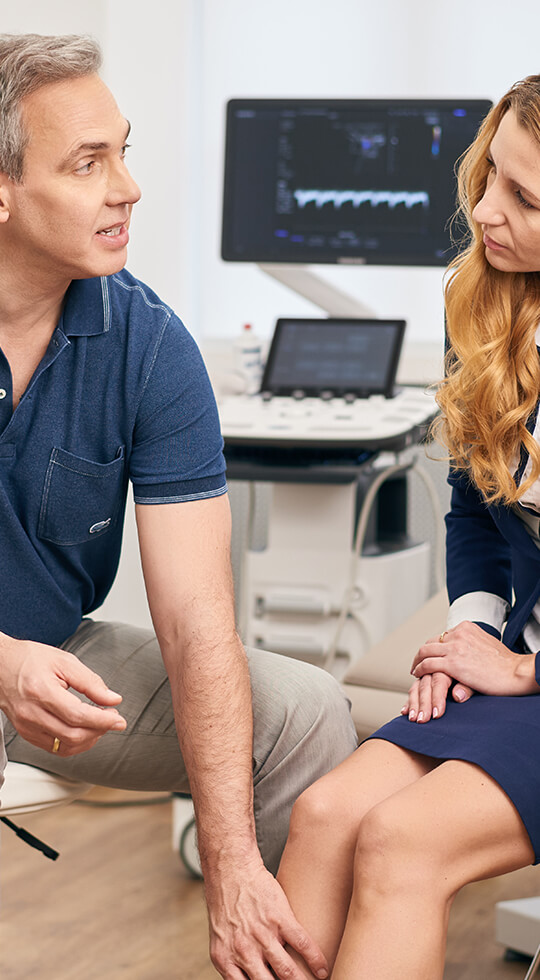
100% Service. For people with statutory and private insurance.
Frequently asked questions to your phlebologist in Düsseldorf
Typical complaints are Feeling of heaviness and tiredness of the affected leg, but also a Constant restlessness may occur in the leg. The legs swell in the ankle region, especially in the evening. More advanced stages then manifest themselves in permanent Skin changes such as brownish discolouration („purpura jaune d`ocre“) and white Scarring („atrophy blanche“) and Thickenings („dermatoliposclerosis“) of the skin, frequent inflammation of the skin („eczema“) and open sores („ulcus cruris“ or skin ulcer).
Nowadays, varicose veins in the large trunk veins (saphenous veins) are treated using an endovenous, minimally invasive and therefore gentle procedure. The so-called heat procedures with laser or radiofrequency or, alternatively, vein glue are available. In heat procedures, the truncal vein is „welded“ from the inside by heat and the vein treated in this way is transformed into a scarred strand that is broken down by the body within several months. The advantage of these procedures over the classic open stripping operation, in which the truncal vein is pulled out of the leg, is that they are less invasive: the vein is simply punctured without an incision and the laser or radiofrequency probe is inserted into the vein and welded from the inside out.
Vein glue, which is used to apply a type of medical superglue (Histoacryl) to the truncal vein and then stick it together by compressing it from the outside, works completely without heat. Foam sclerotherapy (injection of a polidocanol-air mixture into the truncal vein) or the classic stripping operation are also available.
Thanks to modern treatment methods with laser/radiofrequency or vein glue and foam sclerotherapy, invasive treatment of varicose veins is now almost impossible. No pain. In the vast majority of cases, a puncture of the vein or a small cut of the skin is sufficient to create access to the diseased vein. During laser/radiofrequency treatment, anaesthetic is also injected with large quantities of physiological saline solution as a cooling agent around the vein to be treated. This can cause discomfort during treatment. Feeling of pressure in the leg. The gentle treatment methods are characterised by a very low level of pain. However, if necessary, a short and light Sleep anaesthesia If the treatment is carried out by an anaesthetist, the treatment on the leg will not be felt at all.
The classic stripping operation, which involves pulling the truncal vein out of the leg, can cause pain and bruising in the treated leg for a few days, which can be treated well with a compression stocking and painkillers.
Varicose veins can lead to every season be treated - even in summer. The widespread opinion that varicose veins should only be treated in the colder seasons (autumn to spring) is a misconception. Misconception.
Only after sclerotherapy of spider veins or larger varicose veins (not an operation!) should the treated areas be left for a longer period of time. about 6 weeks should not be exposed to direct sunlight, as this can lead to a brownish colour. Skin discolouration (hyperpigmentation) can occur in these areas.
Depending on the chosen treatment procedure, compression stockings should either not be worn at all (vein glue), approx. 14 days after a gentle endovenous procedure such as laser or radiofrequency and approx. 4 - 6 weeks after open vein stripping. However, as patients with untreated varicose veins must wear their compression stockings, particularly in the hot season should wear compression stockings consistently to counteract vein dilation caused by the heat, treatment can also reduce the wearing time of compression stockings in summer. clearly abbreviated become.
The most effective treatment for these dilated fine veins in the skin is the injection of a special alcoholic substance, polidocanol. This causes the vein wall to stick together due to an inflammatory reaction and the spider vein is slowly cultivated by the body over the following weeks. They therefore do not disappear immediately after treatment and remain visible for several weeks. After the treatment, a compression stocking should be worn for 14 days to improve the result and the treated skin area should not be exposed to direct sunlight for 6 weeks. This otherwise leads to increased brownish hyperpigmentation of the skin due to iron released from the red blood cells - a discolouration that often only fades after many months.
In addition to injections of polidocanol, which studies have shown to be the most effective treatment method for spider veins, there is also the option of transcutaneous laser or electrical treatment. However, the results are usually poorer and sometimes leave tiny whitish scars.
The greatest danger of a thrombosis, regardless of whether it is in a deep or superficial vein, is a pulmonary embolism. A piece of the clot is flushed out of the vein with the blood flow and into the pulmonary vessels, where it leads to an oxygenation disorder of the blood. This usually happens in the first 72 hours after the thrombosis occurs. It is therefore important to have an ultrasound scan carried out to check for a possible thrombosis if swelling of an extremity has recently occurred and cannot be explained. If a thrombosis is present, treatment is nowadays almost always on an outpatient basis with further mobilisation (i.e. no bed rest!) and the use of blood-thinning medication for 3-6 months. The use of Marcumar has also been significantly reduced nowadays due to the introduction of the „new anticoagulants“ (so-called NOAKs).
Through a compression of outside the leaky valves in the vein should come closer together and thus be properly repaired. close. This can be achieved using different compression classes of stocking - usually class II for varicose veins.
Compression stockings should be measured by the medical supply retailer in the morning on a slim leg. If the leg deviates from the standard measurements at some measuring points, a compression stocking must be fitted. made to measure which can sometimes take a few days.
The compression stocking is usually only during the day and can be taken off at night.
In the case of mild varicose vein disease, compression stockings are often sufficient to eliminate the symptoms without surgery. However, many patients also like to wear the stockings permanent, because it simply makes the legs feel lighter.
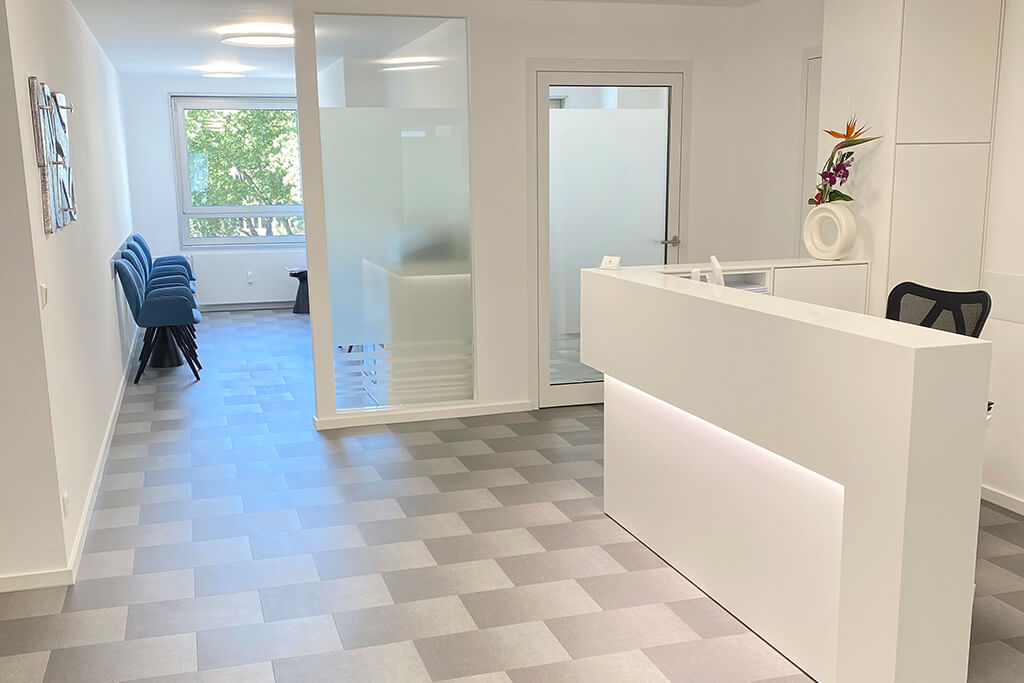
Impressions of the practice