




Lipoedema treatment
Have you been diagnosed with lipoedema and would like to know which therapy is right for you?
Are you suffering from the stresses and strains that come with a lipoedema diagnosis - both physically and emotionally?
Perhaps you are also afraid of a surgical procedure or shy away from the associated costs?
If so, the following lines are intended to give you a comprehensive overview of both conservative and surgical lipoedema treatment.
Lipoedema is a disease - unfortunately still often unrecognised - with a constant lateral increase in subcutaneous fatty tissue on the legs or arms, associated with symptoms such as pain or a feeling of heaviness in the affected extremity.
The diagnosis is usually made on the basis of the symptoms and the physical examination findings (e.g. a positive pinch test). Special laboratory parameters or imaging diagnostics (ultrasound, MRI) do not exist for lipoedema and are used to rule out other differential diagnoses.
What can you expect in my practice as part of lipoedema treatment?
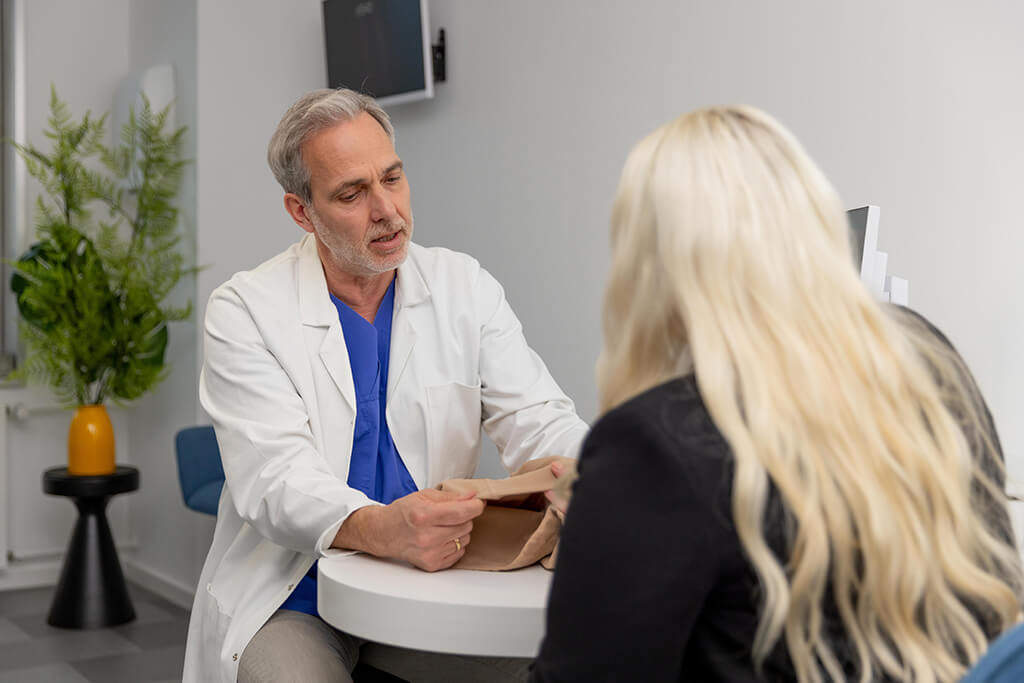
In my private practice, during an initial consultation lasting approximately one hour, a detailed medical history is taken and a physical examination is carried out, using ultrasound if necessary, in order to rule out vascular disease as the cause of your symptoms.
We will then use the examination results to discuss whether or not lipoedema may be present and explain the various treatment options with their specific advantages and disadvantages. Together, we will then draw up the most suitable treatment concept for you.
What therapeutic approaches are there for lipoedema?
In principle, both conservative and surgical treatment options (lipoedema surgery) are available at every stage of lipoedema. Both methods have advantages and disadvantages and these will be presented here.
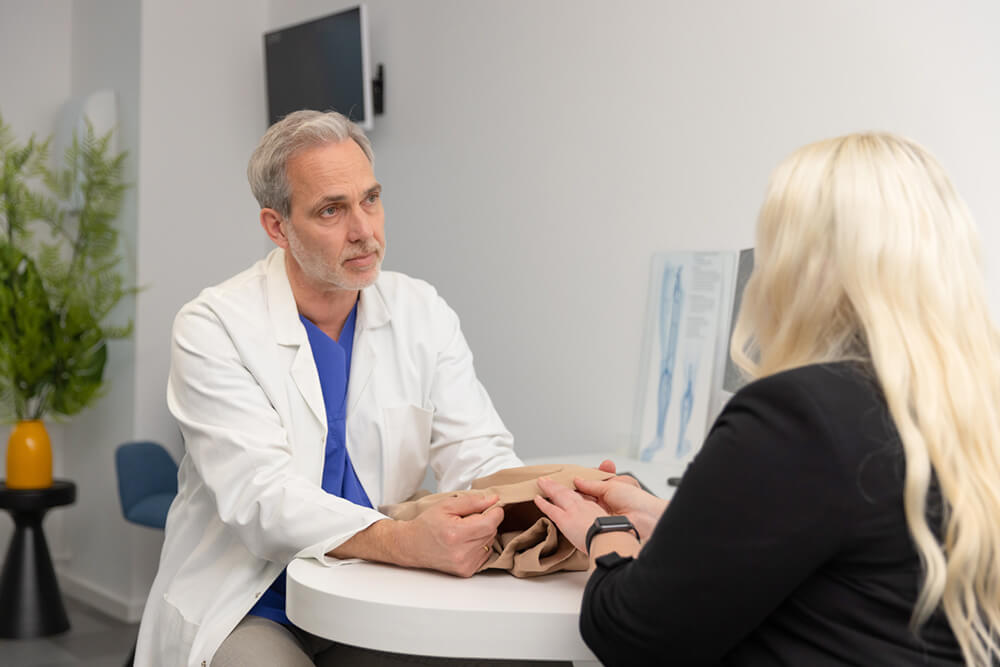
Conservative therapy:
The basis of any conservative treatment for lipoedema is proper nutrition and so-called „complex physical decongestive therapy“ (CDT), consisting of
1. compression therapy (flat knit),
2. manual lymphatic drainage (MLD),
3. exercise therapy and
4. skin care.
1. compression underwear
The aim of compression therapy is to alleviate the pain in the affected extremity. Based on an inflammatory reaction as the cause of the pain in the affected extremity, compression works to reduce this pain by reducing the inflammation.
Flat knit compression garments are the first choice for effective compression, as circular knit compression garments often do not achieve sufficient stiffness to reduce pain. Circular-knit compression is mainly used in the treatment of varicose veins.
If wearing the flat-knit compression underwear during the day does not improve your symptoms, it is usually not advisable to continue compression. Under no circumstances can the compression garment push away the excess fatty tissue.
Compression garments are now available in a wide variety of colours and also in multiple pieces to allow for flexible combinations. A good medical supply store will familiarise you with the characteristics of your specific compression garment and various tips and tricks for using the garment. They will also be able to help you if you experience any problems with your compression garment in everyday life.
2. manual lymphatic drainage (MLD)
Manual lymphatic drainage (MLD) for lipoedema is increasingly controversial in specialist circles. Why? To date, no free fluid has been detected in the soft tissue of the affected extremity in pure lipoedema, either by ultrasound or magnetic resonance imaging (MRI). Consequently, the removal of non-existent fluid by lymphatic drainage does not appear to make sense.
In addition, lymphatic drainage - as with compression garments - cannot massage or push away fatty tissue. However, there are many indications that manual lymphatic drainage with its gentle and stroking movements has a pain-relieving effect and therefore has its place in lipoedema treatment.
MLD can also be supplemented by so-called intermittent pneumatic compression (IPC) at home, in which cuffs applied to the legs or arms are mechanically filled with air. The gentle compression generated reduces the pain in the fatty tissue according to the same principle as the compression girdle.

3. movement therapy
As a lipoedema patient, you should make sure you get enough exercise in your everyday life. On the one hand, exercise supports you in your mental well-being and thus in your mental attitude towards lipoedema, on the other hand, it promotes stabilisation of your body weight and can thus protect you from progression to a higher stage - especially to stage III.
In this context, a few words about exercise for lipoedema: In principle, all exercise is good, but muscle-building exercises are always preferable to pure endurance training, as increasing muscle mass increases your daily energy basal metabolic rate and you therefore burn more calories per day per se. You don't have to go to the gym for this either. There are wonderful exercises you can do at home or outdoors to train highly effectively with your own body weight and build muscle.
This can of course be supplemented by endurance training such as jogging or similar, but with this form of training the body can quickly become accustomed to the strain and may only burn a few calories.
Find the sport that you enjoy the most, because only then will you continue to do it in the long term.
4. skin care
Good skin care is always important when the increased fatty tissue creates skin folds in which infections or fungal infestation can occur due to sweating. You should make sure that the skin environment is acidic and not alkaline, as is unfortunately created by many soaps.
The increased fatty tissue can also lead to the thighs rubbing against each other at the crotch, with consequences for the skin, especially in summer. I recommend consulting a dermatologist if you have skin problems.
Nutrition for lipoedema treatment
Nutrition is a central pillar in the treatment of lipoedema.
The right diet for lipoedema is a comprehensive topic and there is no „one“ diet that suits every patient.
Some patients prefer intermittent fasting, others swear by low-carb or follow the frequently recommended ketogenic diet, in which only a few carbohydrates are consumed, resulting in a permanent change in metabolism with a reduction in the body's own fat reserves.
I recommend reading the relevant specialist literature to deepen your knowledge of the individual forms of nutrition.
Important: Always think about the drinks you consume, as these are often forgotten. We drink a lot of calories without thinking and, treacherously, calories in liquid form do not contribute to the feeling of fullness.
Unfortunately, the solution does not lie in light or zero drinks either, because although they do not contain many calories, they can also lead to an increased release of insulin in the blood via the sweet stimulus produced in the brain. Insulin, however, is the fattening hormone and leads to the build-up of excess fatty tissue in our body.
It is helpful and also sensible to consult a professional in the field of nutrition. A good nutritional therapist can guide you on your individual path to the right diet and work with you to find the diet that really suits you and, above all, your metabolism.
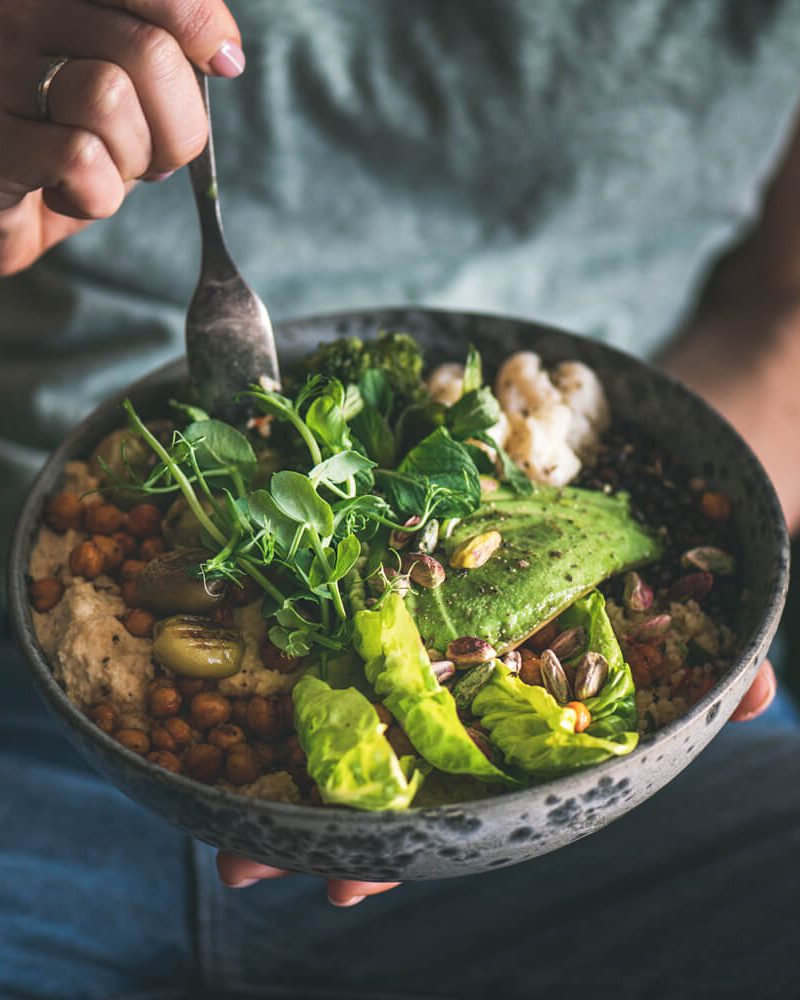
To summarise, conservative therapy has the potential to curb or even completely prevent the progression of lipoedema. By reducing the pain, it can lead to a significant improvement in quality of life.
Surgical therapy: Liposuction:
In principle, the surgical procedure with suction of the increased and painful fatty tissue - so-called liposuction - offers the prospect of lifelong freedom from symptoms.
However, liposuction is no guarantee of permanent freedom from symptoms. Here too, the focus after liposuction is on sufficient exercise and the right diet.
In liposuction, the affected fatty tissue is first soaked in liquid (the so-called tumescent solution) and then suctioned out with a thin cannula through small incisions in the skin - in my practice preferably using vibrational assisted liposuction (PAL). Power-Assisted Liposuction), or water-jet assisted (WAL) on request. With PAL, high-frequency vibration movements of the cannula gently break up the fatty tissue; with WAL, a fine water jet takes over this task. Both methods are gentle on lymph channels, nerves and blood vessels.
The procedure can be performed under local anaesthetic or under a partial or general anaesthetic - on an outpatient or inpatient basis.
Liposuction is the most frequently performed aesthetic procedure in the world today with a very low complication rate.
Who is suitable for liposuction?
In principle, any patient who is not seriously ill and any part of the body affected by lipoedema can be liposuctioned. Only the fatty tissue directly under the skin is removed, liposuction from e.g. the abdomen is not possible - only in the abdominal wall.
Not too much fat should be removed per surgical session, as although the incisions are very small, the wound area under the skin is large and the removal of fatty tissue means a loss of organs for the body.
On an outpatient basis, up to 3 litres of pure fat are usually suctioned out in one session, sometimes even more in individual cases. This always depends on the patient's circulatory situation during the operation.
Under stationary conditions, more fatty tissue can be suctioned out, but this also places greater strain on the body.
What is the aim of liposuction for lipoedema?
The aim of lipoedema is to consistently remove all painful fatty tissue by suction in order to achieve freedom from symptoms for as long as possible.
Of course, an attractive cosmetic result should also be achieved. However, the focus is always on eliminating pain. If there are large amounts of fat, irregularities may remain in the skin after liposuction.
What preparations are needed for lipoedema surgery?
If you decide to undergo liposuction, you will be informed in detail about the procedure, its possible complications and the measures to be taken after the procedure. All questions will be discussed calmly. Always allow yourself sufficient time to think before deciding on the operation.
If you already have a compression girdle, please wear it during the day in the days before the procedure. This can optimise the soft tissue conditions for the procedure. It is not advisable to lose a lot of weight before the procedure, as this can worsen the cosmetic result due to increased sagging of the skin.
If the anamnesis is normal, no further examinations such as laboratory, ECG or X-ray are necessary. In the case of anaesthesia, the anaesthetist decides individually whether further preliminary examinations are necessary - as a rule, they are not.
The operation
On the day of the operation, photos are taken of the areas of the body to be liposuctioned so that they can be compared later. Many patients quickly forget what their body silhouette once looked like. The areas to be liposuctioned will be marked and you will then put on the surgical clothing that you will receive from us.
In the operating theatre, you will be seated on the operating table and the skin will be thoroughly disinfected and the areas of the body to be treated will be sterilely covered.
After a local anaesthetic, several small skin incisions of approx. 0.5 cm in length are made and tumescent local anaesthesia is first applied to the fatty tissue to be removed using a cannula. After a short exposure time with soaking of the fatty tissue, this is then suctioned off laterally with a cannula of approx. 4 mm diameter using the water-jet assisted technique (WAL). During liposuction, you will be awake - in the case of local anaesthesia - and can eat and drink or listen to music.
At the end of the liposuction, depending on the condition of the skin, an additional skin tightening with argon plasma or laser is performed to prevent sagging skin in the suctioned areas.
The remaining tumescent fluid is then manually squeezed out of the tissue, the wounds are closed with sterile strips (adhesive plasters) and then the compression girdle, which you will receive from us, is put on. You should wear the girdle day and night for 6 weeks.
If you feel well at the end of the procedure and your circulation is stable, you will leave our practice accompanied by a relative or friend.
The phase after the operation:
You will usually be exhausted for the first few days after the procedure and I recommend that you take it easy physically during this time. The wounds are usually healed after 14 days and the staple plasters can then be removed. You should wear the compression girdle day and night for 6 weeks.
Intensive post-operative lymphatic drainage by a physiotherapist is important for the healing process in this phase, starting in the first few days after the operation. This removes the wound fluid and the accumulated lymph from the treated leg or arm and loosens the hardening that often occurs in the soft tissue.
In some cases, lymphatic drainage must be continued over a longer period of time and corresponding treatment appointments at the physiotherapy practice should already be scheduled for the operation.
Light sport can be resumed after approx. 4-6 weeks.
After 3 weeks, the treated extremity is often so swollen that a tighter corset can already be applied. For this reason, the first planned follow-up examination takes place in our practice at this time.
You will see the final result of liposuction after approx. 6 months at the earliest. The skin needs up to 12 months to retract over the reduced fatty tissue and thereby tighten and smooth.

Please ensure that you maintain your body weight after the procedure, as otherwise new fat deposits may occur in other areas of the body.
Many women then think that the lipoedema has returned elsewhere. However, your body must somehow store the excess energy that you may have returned to it and it does this again in the form of new fatty tissue. In the process, you will also regain weight in the suctioned areas, albeit significantly less. As the number of fat cells has been reduced by liposuction, the increase is much less visible here than in areas that have not been liposuctioned. At this point at the latest, I recommend professional nutritional counselling to improve your metabolism.
Sometimes psychological support is also useful in order to identify and eliminate unpleasant patterns of eating behaviour.
Of course, we will also look after you after your operation and are happy to be your first point of contact if painful fatty tissue reappears.
Costs of liposuction
As the amount of fat to be suctioned off and the regions to be suctioned off vary from patient to patient, only approximate prices can be given here. Invoicing is always transparent and comprehensible in accordance with the German Medical Fee Schedule (GOÄ).
Counselling interview
approx. 170,- Euro with ultrasound of the leg veins for lipoedema and ca. 50,- Euro without ultrasound for lipohypertrophy.
We would like to point out that we are legally obliged to charge for the initial consultation.
Region 1
Front of the thigh and inside with knee joint on both legs under local anaesthetic.
Region 2
Outer thigh (saddlebags) and back on both legs under local anaesthetic.
Region 5
Abdominal wall (upper and lower abdomen) under local anaesthetic.
Other regions: Price on request
Fat grafting into a region
Lipofilling
- Breasts
- Po
- Hip Dips
plus costs for liposuction
Simultaneous skin tightening
With argon plasma or laser immediately after liposuction (recommended).
All prices are exclusive of VAT, as lipoedema surgery is a medically indicated procedure that is exempt from VAT.
All prices are for a procedure under local anaesthetic. If you require an anaesthetist, additional costs will be incurred for the anaesthetic.
The respective price includes 1 compression girdle. You will receive the girdle from us based on your body measurements, which we will determine on the day of the operation.
As I work purely as a private doctor, the costs of an operation performed by me will not be reimbursed by the statutory health insurance companies if you have statutory health insurance. If you have private insurance or are entitled to a subsidy, you should enquire about the assumption of costs by your health insurance or subsidy office before the operation on the basis of a cost estimate, which I will be happy to provide you with.
Conclusion:
- Both conservative and surgical treatment options are available for lipoedema treatment. Both methods have advantages and disadvantages. We determine the individual treatment plan in a detailed personal consultation.
- Conservative therapy is based on proper nutrition and complex physical decongestive therapy (CDT). This primarily involves wearing a flat-knit compression garment and manual lymphatic drainage.
- All treatment methods - both conservative and surgical - focus on optimising dietary habits and sufficient physical exercise, preferably with muscle building.
- Lipoedema surgery (liposuction) has the potential to permanently relieve symptoms. However, it is an invasive procedure and is associated with costs that usually have to be borne by the patient.
- Today, liposuction is a standard procedure with a very low complication rate and is the most frequently performed aesthetic procedure in the world.
- At Dr Kusenack's vascular practice in Düsseldorf, we advise and support you in the treatment of your lipoedema. We can treat you conservatively or perform liposuction on an outpatient basis, preferably under local anaesthetic (tumescent local anaesthesia).
FAQ | Frequently asked questions about lipoedema treatment:
Lipoedema is not curable according to current knowledge - although research is still in its infancy.
However, a higher stage can regress to a lower stage (e.g. stage II after stage I) if appropriate conservative or surgical treatment is carried out.
A reduction from stage III to a lower stage II is also conceivable through treatment of simultaneous obesity.
Lipoedema cannot be cured. Surgical intervention (lipoedema surgery) by means of liposuction offers the best chance of permanent freedom from symptoms. However, purely conservative therapy can also lead to freedom from symptoms.
In principle, any form of exercise is good. Both endurance and weight training can help to keep lipoedema under control.
Many patients combine different types of sport. However, endurance sports usually no longer lead to a loss of fatty tissue after a certain point, as the body gets used to the strain.
Exercises to build muscle lead to an increase in the daily basal metabolic rate per se through muscle growth.
Hormonal changes are discussed as a trigger for a lipoedema flare-up, i.e. the onset of puberty or the menopause, as well as pregnancy.
However, prolonged stress situations are also possible, which can lead to increased fat storage due to persistently high cortisol levels in the blood.
Unfortunately, the exact triggers of a lipoedema flare-up are still unknown and research is still in its infancy.
Recovery after lipoedema surgery varies from patient to patient. There are no generally applicable recovery times. As a rule, you will not be able to work for the first week and will need a certain amount of time to recover. You will receive a sick note from me for this period, or even longer if necessary. In most cases, however, you will be able to resume your daily work routine in the second week. Pain usually persists during the first week and is comparable to severe muscle soreness in the area of the liposuctioned regions. I will provide you with sufficient painkillers and my mobile phone number, where I can always be reached (7/24). In this context, it is very important to wear a compression garment day and night for 6 weeks and to have regular manual lymphatic drainage by a physiotherapist (2-3 times a week) to remove the lymphatic fluid and wound fluid produced after the operation.
The risks of conservative lipoedema therapy ultimately only consist of a possible failure of the therapy. There are generally no side effects with conservative therapy. Liposuction is a surgical procedure and therefore naturally involves the classic surgical risks such as the risk of thrombosis, infection, soft tissue swelling or nerve damage. I will discuss and explain all the risks during the consultation. As a rule, however, there are no serious complications; post-operative pain is normal in the first few days and can be treated well with appropriate pain medication. From a cosmetic point of view, skin irregularities may remain after liposuction.
In preparation for liposuction, please try to keep your body weight stable. It is not advisable to lose a lot of weight before the operation as this can increase the risk of sagging skin after the procedure. It is also important that you prepare yourself for the consultation with your doctor, e.g. by writing down questions on a piece of paper in advance that you might otherwise forget during the consultation due to your excitement. Ask every question that is important to you. A responsible doctor will go through all the questions with you and try not to leave any points unanswered. Ultimately, liposuction is, of course, a surgical procedure, but in the hands of an experienced colleague it is associated with a very high level of safety for you.
Weight loss in the areas affected by lipoedema is possible despite lipoedema. However, the body silhouette with its different proportions does not usually change as a result.
Only liposuction can restore the correct proportions by selectively removing the excess fatty tissue (so-called liposculpture).
The costs for the conservative treatment of lipoedema with the wearing of compression garments and manual lymphatic drainage are normally covered by statutory and private health insurance companies. Surgery, however, is still generally a self-pay service.
Regarding the costs, please refer to the section „Costs of liposuction“. The prices for liposuction in our practice are calculated transparently and comprehensibly according to the scale of fees for doctors (GOÄ).
This question is currently the subject of heated and critical debate among experts.
As it has been proven that there is no increased water in the soft tissue in lipoedema that could be drained away, the positive effects of lymphatic drainage appear to be concentrated on reducing the perceived pain through the gentle stroking movements.
It is not possible to massage or push away the increased fatty tissue with lymphatic drainage.
The first step is a consultation lasting just under an hour, during which the patient's medical history is taken to determine the symptoms and a physical examination is carried out and, if necessary, an ultrasound examination of the legs is performed to rule out internal, invisible varicose veins. An ultrasound examination of the arms is not advisable, even if there are symptoms, as there are no varicose veins here. The best possible course of treatment is then worked out together with the patient. In the case of conservative treatment, I will support the patient with the appropriate prescription for lymphatic drainage and compression stockings (for private patients). If you are covered by statutory health insurance, I recommend that your general practitioner writes a prescription for the statutory health insurance companies to cover the costs, as I can only issue a private prescription as a private doctor. If you decide to undergo surgery, I will explain the surgical procedure and further behavioural measures in detail during a detailed consultation. The operation is performed in my practice under outpatient conditions and preferably under local anaesthetic - if desired, together with an anaesthetist under general anaesthetic or twilight sleep. Further post-operative checks are also carried out in my practice until the treatment is completed.
Lipoedema surgery on the entire leg is usually performed in three sessions to minimise the circulatory strain. In the first session, the increased and painful fatty tissue on the front and inside of the thighs and the patient's knee region is suctioned off, in a second session the outer and back of the thighs and finally, in a third operation, the lower legs are circularly removed. The order of the operations and the question of whether all three procedures are necessary at all naturally depends on the individual findings and the patient's wishes. The arms are usually operated on in one session, and only one surgical session is required for the abdominal wall and/or flanks. A combination of several body regions should not be performed under outpatient conditions, as too much fat would then have to be suctioned out with an unnecessarily high and possibly dangerous strain on the circulation (fat loss is organ loss). Under inpatient conditions, slightly more fat can be suctioned off individually.
Further information on lipoedema
What is lipoedema
Symptoms
Stadiums
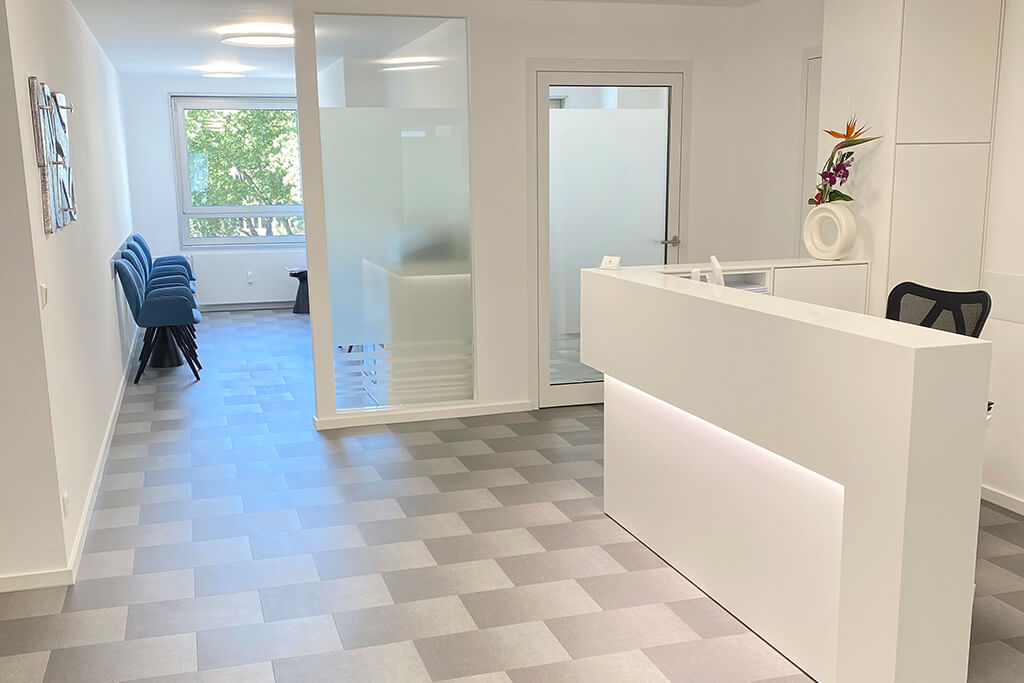
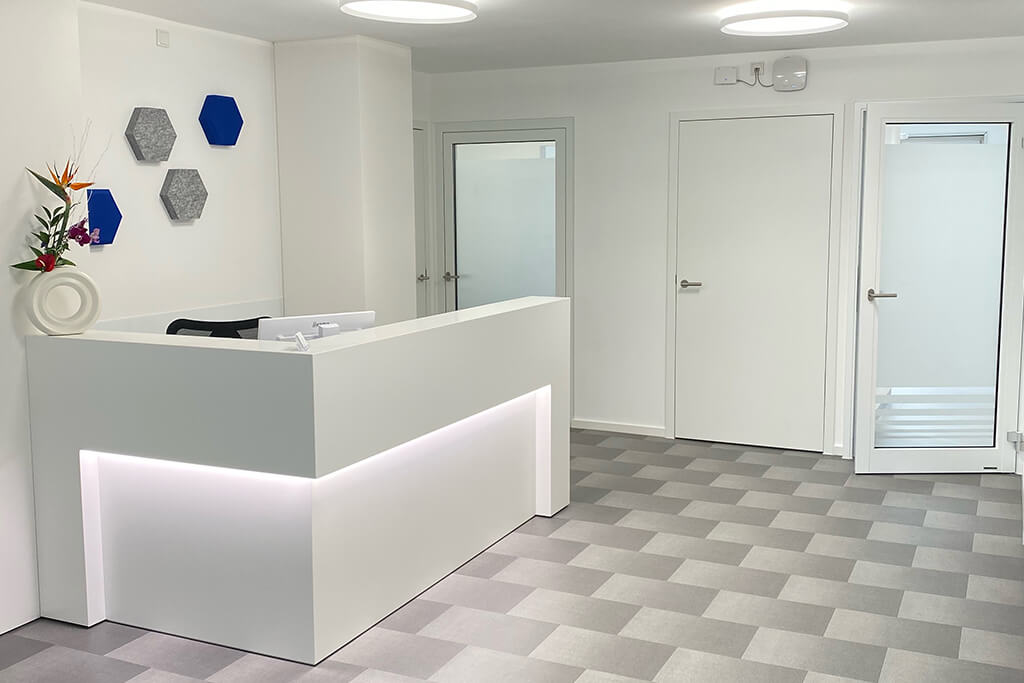
Impressions of the practice