



Removing varicose veins over the course of time
Until the end of the last century, every varicose vein in the truncal vein had to be treated with the classic stripping operation - the surgical removal of varicose veins - via an incision in the groin, today the gentle, so-called endovenous procedures the treatment method of choice. The term „endovenous“ means that the procedure can be inside the vein laser therapy and radiofrequency ablation, closely followed by the latest procedure: vein glue.
Removing varicose veins with laser or radiofrequency
In the laser or radiofrequency procedure, the attending physician performs the treatment via a small puncture to insert a probe into the diseased truncal vein on the front or back of the leg and advances it to where it joins the deep vein (usually in the groin or knee bend). At the tip of the probe, the Laser or radiofrequency heat with temperatures of up to 120° Celsius in the vein, which leads to „welding“ of the vein wall as the catheter is slowly and gradually withdrawn. This means that the vein no longer has to be pulled out of the leg with several skin incisions, as was previously the case, but can remain in the leg during the treatment. This has several decisive advantages, which are discussed in more detail below. Over the next few months, the vein damaged in this way is transformed by the body into a connective tissue strand and then finally broken down. The entire treatment is carried out under constant monitoring with ultrasound, also known as „Eye of the phlebologist“. With this „eye“, all treatment steps can be closely monitored and precisely controlled during the procedure. In order to protect the surrounding tissue from the heat, sterile saline solution is injected into the leg around the vein like a kind of coolant. Depending on the patient's wishes, the procedure can be performed under a light sedation or local anaesthetic, in which case a local anaesthetic is added to the coolant.
Advantages of gentle varicose vein removal
The advantages of this method are immense:
- Significantly less injury to the soft tissue surrounding the vein, as the vein no longer has to be pulled out, resulting in much less painful bruising (haematoma) after the procedure.
- Due to the reduced soft tissue damage, there is less strain on the entire body and the risk of infection is lower than with open surgery.
- Compression stockings only need to be worn for a fortnight after endovenous therapy and not six or more weeks after open surgery as was previously the case.
- Overall, mobility is regained more quickly and the patient can usually resume their daily routine/occupation the following day.
- Blood-thinning medication does not have to be discontinued for the procedure.
- The procedure is almost always performed on an outpatient basis.
Removing varicose veins with the vein glue
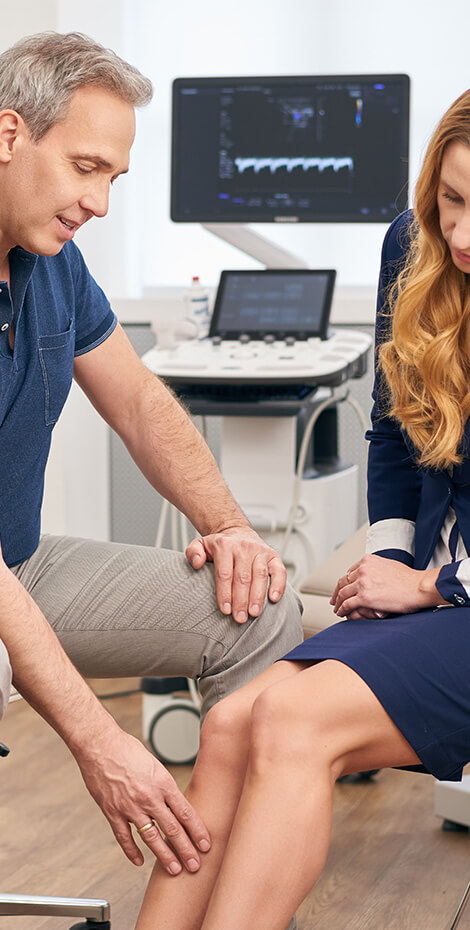
The current gentlest but also the most expensive treatment method is the so-called vein glue. This involves puncturing the diseased vein under local anaesthetic with a diameter of approx. 1 cm under ultrasound guidance and inserting a small catheter into the entire diseased section of the vein. The adhesive (cyanoacrylate) is then applied via this catheter in a punctiform manner and the vein wall is glued by applying pressure from the outside with the hand in a similar way to a superglue.
The biggest advantage compared to heat procedures with laser or radio frequency is the lack of heat effect on the surrounding tissue and No coolant needs to be injected either. The patient gets up from the treatment table immediately after the procedure, is Fully mobile immediately and can fully resume their everyday life and professional activities on the same day. Compression stockings also do not need to be worn after treatment with the vein glue. Unfortunately, however, it is currently the most expensive treatment procedure of all for varicose vein disease of the truncal vein and the adhesive alone costs over 1,000 euros. Many private health insurance companies now cover the costs of this procedure, but statutory health insurance companies do not.
Removing varicose veins - which therapy and when and what are the costs?
Ask your doctor about the various treatment methods and their advantages and disadvantages. Many roads lead to Rome and there are often several treatment options for your specific condition Doctors who specialise in the treatment of veins (so-called Phlebologists), generally offer all treatment procedures and will advise you on of your individual findings on the best therapy procedure for you in a detailed discussion.
Many statutory health insurance companies now cover the gentle endovenous procedures (laser and radiofrequency), which cost between approx. 1,200 euros for one leg and approx. 1,800 euros for both legs. However, many statutory payers still only pay for the classic stripping operation. You can easily enquire with your insurer which procedure is covered by your health insurance. Private health insurance companies always cover the costs of lasers and similar procedures.
Frequently asked questions about varicose vein pulling
„Pulling varicose veins“ refers to the classic stripping procedure: The diseased trunk vein is surgically removed from the leg via an incision in the groin. This method is now considered outdated - modern endovenous procedures replace it in most cases.
Compression stockings alleviate symptoms but do not cure varicose veins. Anyone with symptoms or progressive vein disease should have varicose veins removed - a phlebologist will use ultrasound to assess which procedure is necessary.
Instead of removing varicose veins, gentle endovenous procedures are now available: Laser therapy, radiofrequency ablation and vein glue (cyanoacrylate). All three methods treat the vein from the inside without pulling it out.
The doctor inserts a probe into the diseased vein via a small puncture. Laser or radio frequency generate heat of up to 120 °C, which welds the vein wall. The procedure is performed on an outpatient basis under ultrasound guidance, local anaesthetic or light sedation.
Many statutory health insurance companies cover laser and radiofrequency procedures (approx. €1,200 per leg, approx. €1,800 for both legs). Some still only pay for classic varicose vein removal by stripping. Private insurers usually cover endovenous procedures. It is best to enquire directly with your insurer.
