





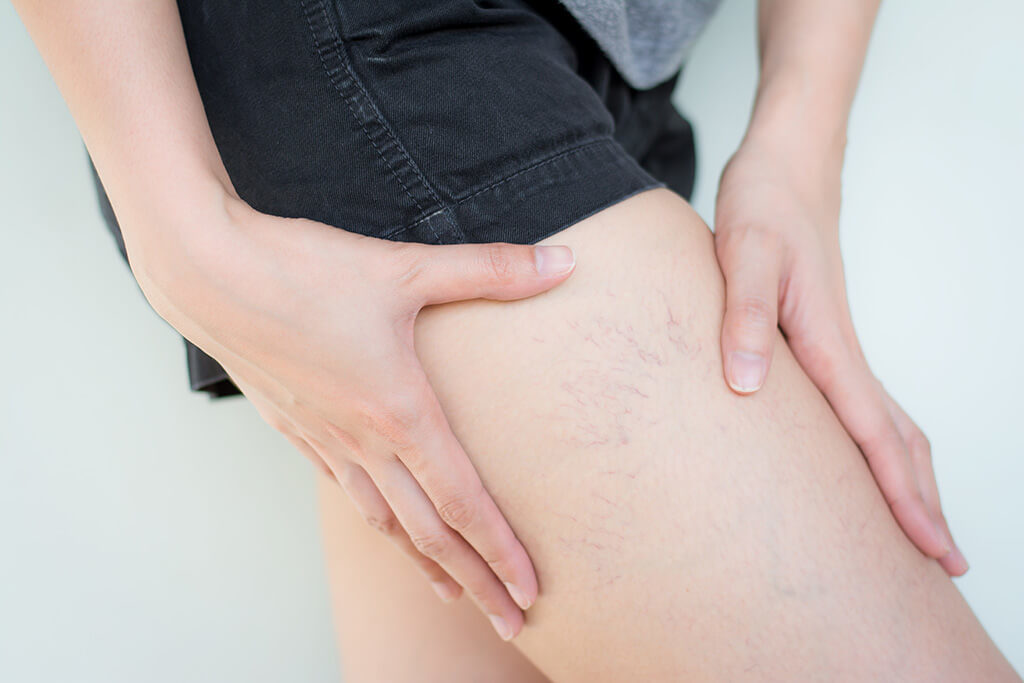
Targeted treatment for spider veins is therefore often sensible from both a medical and cosmetic perspective. Spider veins are the finest, dilated veins with a maximum diameter of 1 mm, which run superficially and locally confined in the skin. Medically, they belong to varicose veins and are therefore a condition, even if they are only a cosmetic nuisance for most of us. They are visible to the naked eye and often appear as branch-like reddish-blue lines shimmering through the skin. Spider veins mainly occur on the legs. Men and women are affected roughly equally. They get their name from their appearance: with their typical branching pattern, they resemble birch twigs, which were formerly bound together to make brooms – hence the name „Besenreiser“ (literally "broom veins").
Do spider veins cause discomfort?
Very few spider veins cause discomfort to their wearer. However, burning pain, a feeling of pressure or warmth or swelling in the area of the spider vein can occur from time to time. Whether spider veins themselves can lead to the development of larger and therefore relevant varicose veins has not yet been clarified.
Dubious home remedies for spider veins
The desire for attractiveness is as old as mankind itself. For this reason, attempts were made early on to combat these disturbing vascular dilatations. One of these ways was the use of vegetables:
Unripe tomatoes or sprouting potatoes contain the toxic alkaloid solanine, which should not be consumed. External application to the affected areas for several weeks is said to make the spider veins appear less visible. However, this is by no means proven.
Natural substances such as apple vinegar, garlic, lemon or mountain pine oil, spruce extract, arnica or Ringer's flower ointment are also said to stimulate blood circulation. Applied to the affected areas several times a day for a few weeks, they are said to promote the drainage of blood from the spider veins. This is said to cause the veins to fade slightly. A similar effect is also attributed to salmon, avocado, ginkgo biloba, goji berries, garlic, ginger, buckwheat or sweet clover tea.
Spider vein treatment: Is diet an effective remedy for spider veins?
Vitamin C, zinc and flavonoids are said to strengthen the vein walls and valves. Acerola fruit, rose hips, nettles, blackcurrants and peppers, for example, are rich in vitamin C. Good sources of zinc include shellfish, offal, meat, pulses, dairy products and eggs. Flavonoids can be found in arnica flowers, birch leaves, buckwheat, elderflowers, camomile flowers, hop cones and dark chocolate.
However, an increased intake of these nutrients in their effect on the development and treatment of spider veins has not been proven.
Leeches as the „somewhat different“ remedy for spider veins
In leech therapy, leeches are placed on the skin near the spider veins. As they suck the blood, they release anti-coagulant and anti-inflammatory substances, which supposedly leave the veins visibly paler. The leeches fall off on their own after about thirty minutes. Unfortunately, this type of therapy does not last long. After a short time, the veins fill up with blood again and the spider veins become visible again.
What are potentially effective remedies for spider veins?
Studies have shown that the active ingredient aescin from horse chestnut stabilises the vein walls in some patients and thus reduces the outflow of fluid into the tissue. This can also have a preventative effect against water retention (so-called oedema). A similar effect has also been found for red vine leaf extract. Both preparations are available over the counter in the form of ointments and tablets.
When consumed daily, basil is said to help shrink spider veins thanks to its high vitamin K content. The effect was tested at the University of Maastricht and is said to be visible after around six weeks.
It is not possible to predict whether the active ingredients described here will have an effect on the individual and can only be determined by trial and error.
Furthermore, cold watering after showering for approx. 5 minutes per leg stimulates the tone of the vein wall and can lead to a reduction in spider veins.
Wearing compression stockings regularly can also counteract the worsening of spider veins.
And what is really an effective remedy for spider veins?
Medically proven to be effective for the treatment of spider veins is the injection of Polidocanol into the spider vein. This is an alcoholic solution that, after injection into the spider vein, irritates the vein wall and, through an inflammatory reaction, leads to the shrinking of the dilated vein and thus the breakdown of the spider vein within several weeks. Those who specifically Sclerotherapy wishes to have removed, will find this method under the term sclerotherapy – a well-established procedure that is also used for Sclerotherapy can be supplemented with a laser or high-frequency probe. For certain manifestations of spider veins, transdermal laser treatment can also be attempted. Good results have also been described with heat application using a high-frequency probe to cauterise the spider veins.
Spider veins sometimes just the „tip of the iceberg“
However, it should always be checked whether there is a deeper, more extensive varicose vein formation behind the spider vein, which is not visible from the outside and is the real root of the problem. The spider vein is then only the „tip of the iceberg“.
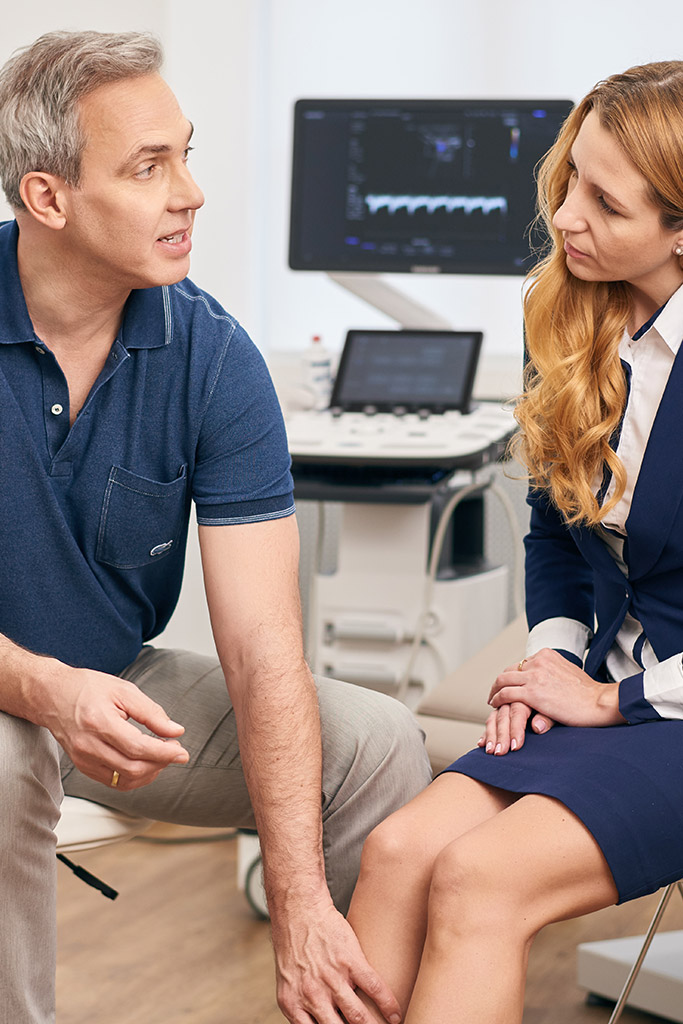
A painless ultrasound examination by a vein specialist (phlebologist) quickly provides clarity and is recommended for any spider vein formation.
Sometimes, spider veins can hide a deeper varicose vein condition – find out more about treating spider veins on our services page Spider veins. Our article informs about the medically proven sclerotherapy treatment Vein sclerotherapy - what are the risks of the treatment?. We explain the causes and treatment of varicose veins in general on our website. Varicose veins. If you have questions about complaints and symptoms, I recommend our article What are the symptoms of varicose veins?.

Dr Ulrich Kusenack
Specialist in Surgery & Vascular Surgery · Private Practice Düsseldorf
Dr. Kusenack has been working in vascular medicine for over 25 years – most recently as Chief Physician of the Department of Vascular Surgery at Helios University Hospital Wuppertal. In his private practice on Königsallee in Düsseldorf, he treats patients with lipoedema and varicose veins, and performs liposuction.
To the doctor's profile