




Lipoedema is playing an increasingly important role in public perception. Social media certainly plays a large part in this - more and more celebrities are „coming out“ and making their lipoedema condition official. In doing so, they also talk about the treatment path they have taken, giving many sufferers initial inspiration and support.
Lipoedema therapy can be conservative or surgical.
Conservative lipoedema therapy - what is it?
Conservative lipoedema therapy involves wearing compression garments and regular manual lymphatic drainage (MLD for short) to reduce the pain in the subcutaneous fatty tissue. It is assumed that the pain in lipoedema results from a slight inflammatory reaction in the subcutaneous fatty tissue. The use of compression can generally counteract inflammation. Wearing compression garments as an essential pillar of conservative lipoedema therapy can reduce the pain in the fatty tissue via this mechanism of action.
Manual lymphatic drainage is the second main pillar of conservative lipoedema therapy. However, lymphatic drainage does not focus on the actual purpose of lymphatic drainage - the removal of fluid from the extremity or its „decongestion“. Rather, the lymph therapist's gentle, stroking touches are intended to stimulate the parasympathetic nervous system, which has a calming effect, thereby reducing the pain of lipoedema.
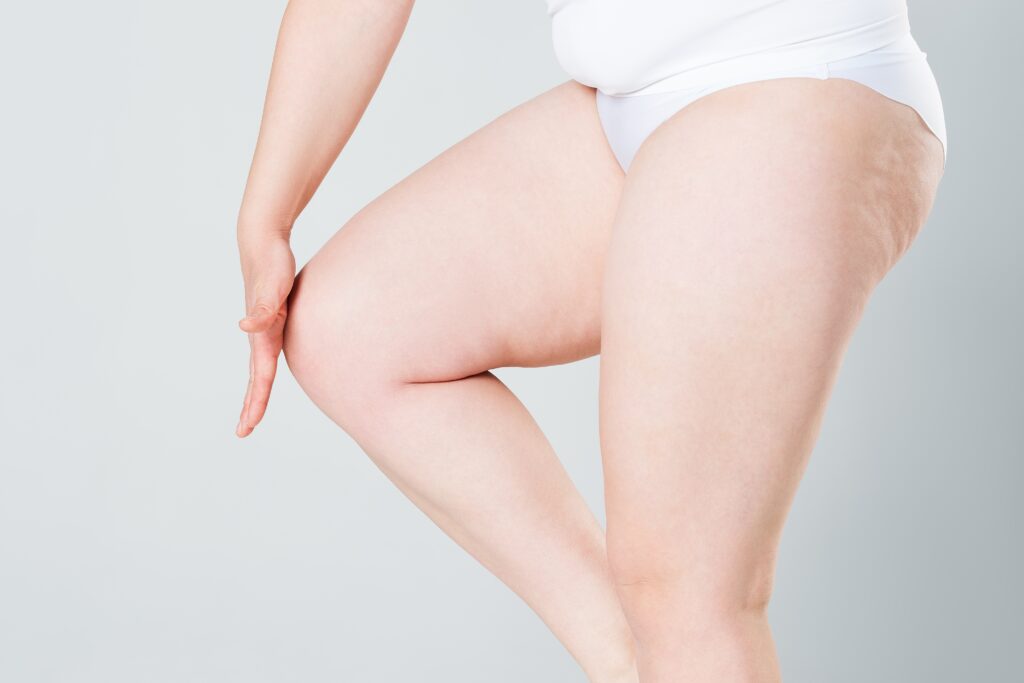
Proper skin care is also an essential part of conservative lipoedema therapy: certain areas of skin can rub against each other due to the increased fatty tissue - the crotch on the inside of the thigh is very popular. Proper skin care - especially in warm temperatures - prevents irritation on the affected areas of skin.
Last but not least, every sufferer should make sure they get enough exercise in their everyday life, as good mobility improves their overall attitude to life and can also help them to distance themselves from the pain they feel. In addition to a balanced diet, it helps to reduce calories and improve body weight and body perception.
Surgical lipoedema therapy - often a permanent solution.
If conservative treatment does not lead to an improvement in quality of life, there is always the option of surgery to remove the painful fatty tissue - liposuction. In this procedure, small incisions are made through the skin (approx. 0.5 cm in length) and the excess and painful subcutaneous fatty tissue is sucked out using a thin suction cannula. This procedure usually leads to freedom from symptoms and therefore to a rapid improvement in quality of life. The procedure can preferably be performed under local anaesthetic or, at the patient's request, under general anaesthetic together with an anaesthetist. However, the procedure is also associated with the possibility of complications, although these only occur very rarely.
The advantage of surgical lipoedema treatment using liposuction over conservative treatment is also the improvement of the body silhouette and therefore the external appearance.
Many patients have undergone a long course of conservative treatment before deciding to undergo surgical treatment for lipoedema.
However, there are also patients who primarily opt for surgical lipoedema treatment. It is always up to the individual patient to decide which route to take first. This often also depends on the patient's current circumstances and financial means, as conservative lipoedema treatment is usually covered by health insurance, but surgery almost always has to be paid for by the patient herself.
Advantages and disadvantages of lipoedema therapies:
The advantage of conservative lipoedema therapy is that the costs are covered by health insurance and the patient's own body remains intact. The disadvantage of conservative lipoedema therapy is that it often does not lead to real freedom from symptoms and wearing compression garments can be particularly uncomfortable in warm temperatures. Conservative therapy also does not change the external appearance.
In contrast, surgical lipoedema therapy can sometimes lead to rapid and permanent freedom from symptoms. The disadvantage of the operation is its invasive nature with the - albeit rare - possible complications of liposuction and the fact that the procedure is generally a self-pay service.
Comprehensive information about both methods of lipoedema therapy is essential
It makes absolute sense for those affected to inform themselves in detail about both options for lipoedema therapy in order to be able to make an informed and self-determined decision for their own path.
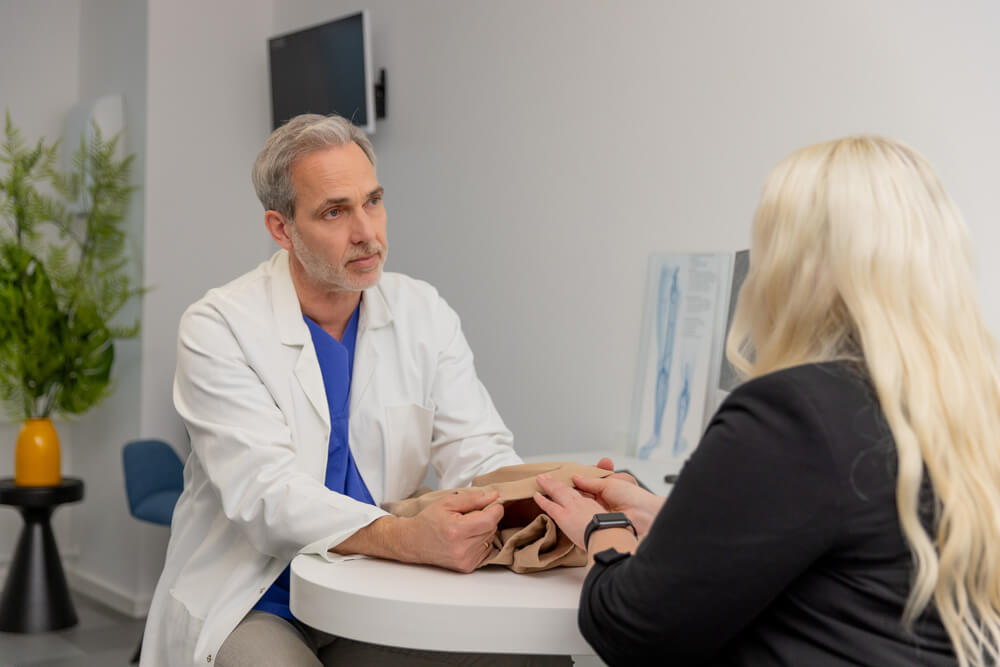
Many patients who come to my consultation want to know whether they have lipoedema at all. Once the diagnosis has been made, I always advise the patient on both treatment options and recommend a sufficient period of reflection.
However, many patients also want to find out directly about the exact procedure of an operation and the behavioural guidelines after the procedure. This is important in order to be able to plan the right time for surgery in lipoedema therapy.
Is there „the“ right way to treat lipoedema?
No, there is of course no „right“ way to treat lipoedema. This approach may also change over time and what was originally a conservative approach may ultimately become surgical treatment. Many patients who come to my consultation have already undergone several years of conservative lipoedema treatment with wearing compression garments and manual lymphatic drainage and are now ready for liposuction due to their level of suffering.
However, please bear in mind that liposuction in lipoedema therapy is primarily intended to relieve you as a sufferer of your pain. The body silhouette will of course also change as a result of liposuction, but the appearance of irregular skin cannot be ruled out even after liposuction. However, an experienced surgeon will do everything to ensure that the cosmetic result after liposuction is also pleasing.
Frequently asked questions about lipoedema therapy:
There is both conservative and surgical lipoedema therapy. Both procedures have their specific advantages and disadvantages and are discussed in a detailed consultation with a doctor experienced in the treatment of lipoedema.
Conservative lipoedema therapy consists of 4 elements: 1. wearing compression garments, 2. manual lymphatic drainage, 3. good skin care and 4. sufficient exercise and improvement of dietary habits.
During liposuction, a fine suction cannula is inserted under the skin through small incisions and the excess and painful fatty tissue is sucked out and surgically removed. As a result, a very high percentage of patients can be completely and permanently free of symptoms.
In a detailed consultation with a doctor experienced in the treatment of lipoedema, the advantages and disadvantages of both treatment methods will be discussed with you. Many patients start with conservative lipoedema treatment and decide to have surgery if conservative treatment does not improve their symptoms. However, there are also patients who are permanently treated conservatively and patients who decide to have surgery right from the start.
The effectiveness of purely conservative lipoedema treatment without surgery, including dietary changes, wearing compression garments and manual lymphatic drainage as well as sufficient exercise, can be good in the long term and lead to a significant improvement in symptoms. However, many patients do not want to go down this route and surgery offers the prospect of lifelong freedom from symptoms, even if this is not guaranteed and a cure is not possible at the current stage of research.
The right time for lipoedema surgery is always when conservative therapy is unable to achieve freedom from symptoms or the patient wishes to achieve this freedom from symptoms quickly. Significant excess weight can be a reason to postpone the operation for the time being. Sometimes, however, it also makes sense to improve the patient's quality of life through liposuction, especially if she is overweight, and thus pave the way for weight reduction by changing her lifestyle (diet, exercise).
Diet and exercise are a fundamental pillar of lipoedema therapy, regardless of whether the patient opts for surgery or conservative treatment. Even with lipoedema, you can only put on weight if you are eating the wrong food or exercising too little, or if you have a metabolic disorder (e.g. hypothyroidism), as the body always converts excess energy into fat - it cannot do otherwise. There is no self-proliferating fatty tissue, as is often attributed to lipoedema fat, as this is not possible at all according to the laws of physics (law of conservation of energy). You can also gain or lose weight with lipoedema depending on your diet, exercise or metabolic settings. This is very important to understand because it means that you are not helplessly at the mercy of the disease, as is so often claimed in the social media. If diet and exercise are not sufficiently taken into account after lipoedema surgery, this can quickly lead to renewed weight gain and thus to a recurrence of lipoedema symptoms.
Holistic treatment planning for lipoedema begins with an anamnesis - and in particular the symptoms - and a physical examination of the patient. Depending on the symptoms, a supplementary ultrasound examination of the legs may be useful and indicated. The advantages and disadvantages of conservative or surgical treatment are then discussed and a personalised treatment plan is drawn up depending on the patient's level of suffering and treatment requirements. We reserve a time slot of approx. 1 hour for the initial consultation for every new patient, even if this is not always necessary.
The costs of conservative lipoedema treatment are generally always covered by statutory (only by panel doctors) and private health insurance companies. The situation is different if a surgical procedure (liposuction) is planned. In this case, an attempt can be made to obtain partial or perhaps even full funding from the private health insurance company in advance by submitting a cost estimate. With statutory health insurance companies, this is currently only possible for stage III lipoedema. However, this may change in the future once the results of the recently completed LipLeg study (liposuction for all stages of lipoedema) have been analysed and implemented by the G-BA.
