





Lipoedema symptoms
What is lipoedema and what is it not?
Lipoedema is an increase in subcutaneous fatty tissue on the extremities, mainly on the legs and occasionally also on the arms, which always occurs symmetrically and is always accompanied by symptoms. Hands and feet are always spared from the change.
The increased fatty tissue often leads to a disproportion between a slim upper body and a broad lower body - but this does not have to be the case. There are also lipoedema patients with harmonious body proportions.
According to current research, lipoedema does not occur on the abdomen, chest, torso, face and neck.
Lipoedema is always accompanied by symptoms, but these can vary from person to person and this is often the difficulty in making a medical diagnosis. In most cases, there is spontaneous pain in the affected extremity or pain when touched, e.g. by a partner. Children or pets sitting on the lap can also trigger symptoms. Occasionally, the affected extremity only feels heavy.
The cause of the symptoms is still completely unclear at the present time, but there may be an inflammatory reaction in the affected subcutaneous fatty tissue. Increased dead fat cells are being discussed as a possible trigger for this inflammation.
It follows from this definition of lipoedema that increased fatty tissue without symptoms - even if it is persistent in the face of exercise and diet - is not lipoedema. Instead, this condition of increased fatty tissue without symptoms is referred to as „lipohypertrophy“.
Lipohypertrophy - as long as there is no additional obesity - has no disease value and therefore does not need to be treated from a medical point of view.
To date, there is no scientific evidence that lipoedema is a constantly progressive - i.e. inexorably advancing - disease. Nevertheless, this is still stated in the first German guideline on lipoedema from 2015. This aspect in particular is often picked up on in the social media, creating fear among the unsettled readership.
In any case, the term „lipoedema“ was unfortunately chosen by the first two authors, Allen and Hines, as the word „oedema“ always means a swelling of tissue due to water retention.
However, although often propagated, there is no water retention in the tissue in lipoedema and this clearly distinguishes lipoedema from other diseases such as lymphoedema.
In lymphoedema, tissue water (lymph) collects in the subcutaneous fatty tissue and leads to swelling of the affected limb.
In certain cases, however, lipoedema can still lead to water retention, and this is always the case if the patient is significantly overweight in addition to having lipoedema, as obesity can lead to lymphoedema.

Experts have therefore been calling for a name change for some time because there is actually no oedema in lipoedema. The favoured term here is lipohypertrophy dolorosa (painful increased fatty tissue).
However, the word „lipoedema“ has already become established among the general public, which will make an actual name change difficult.

What are the symptoms of lipoedema?
Lipoedema often changes the external appearance. Many patients with lipoedema have a slim upper body and a wider lower body with increased fatty tissue on the hips and legs. In some cases, there is a difference in clothing size of two dress sizes.
However, not every woman with similar body proportions also has lipoedema, although this reverse conclusion is often propagated in the media.
Lipoedema also occurs in slim women who, for example, only have increased fatty tissue in the knee joint area, which causes them pain. However, the body silhouette is still completely harmonious.
As the pain in lipoedema is uncharacteristic and the symptoms sometimes only consist of a feeling of heaviness in the legs, other diseases must also be included in the differential diagnosis. For example, varicose veins or changes in the lumbar spine with radiation to the legs can cause similar symptoms.
The appearance of the skin can be completely normal and smooth (lipoedema stage I). However, it can also be wavy like cellulite (lipoedema stage II) or appear as overhanging fat folds (so-called dewlap in stage III). Of course, the reverse is not true here either, i.e. a corresponding skin appearance does not mean the presence of lipoedema.
There are a number of other symptoms that are often taken as an indication of the presence of lipoedema but often have nothing to do with the disease. These are
- Despite exercise and a change in diet, fat tissue cannot be lost.
- The fatty tissue under the skin is coarse nodular.
- The skin feels cold.
- Rapid and frequent occurrence of bruising without any recognisable cause.
Causes for the occurrence of lipoedema
The causes for the occurrence of lipoedema are still completely unexplained and are the subject of current lipoedema research.
As lipoedema almost exclusively affects women (although there are also very few affected men), a hormonal trigger is suspected, particularly at the onset of puberty, pregnancy or the onset of the menopause.
However, a genetic predisposition with inheritance through the female line is also suspected. However, it is also possible that certain eating habits are passed on from generation to generation.
It is noticeable that lipoedema often occurs together with obesity (overweight with a BMI > 30). Many affected women started dieting at a young age under the impression of certain beauty ideals and embarked on the painful path of the well-known yo-yo effect.
How does the doctor diagnose lipoedema and is there a self-test for lipoedema?
The most important indications of the presence of lipoedema are the patient's medical history (anamnesis) and the complaints described by the patient, as well as the physical examination findings (palpation).
Unfortunately, there are no specific laboratory parameters or abnormalities in ultrasound or magnetic resonance imaging (MRI) to detect lipoedema.
However, as lipoedema always involves symptoms, a palpation of the affected areas of the body and a pinch test can provide indications of the presence of lipoedema. In this test, the doctor pinches the subcutaneous fatty tissue below the inside of both knee joints or above the elbow on the underside of the arms. If pain occurs, lipoedema may be present. You can also carry out this test yourself.
You may also have lipoedema if you can answer „yes“ to one of the following points:
- The fatty tissue under my skin on my legs or arms feels painful
- If my partner touches my legs or arms or if children/pets sit on my lap, it feels uncomfortable
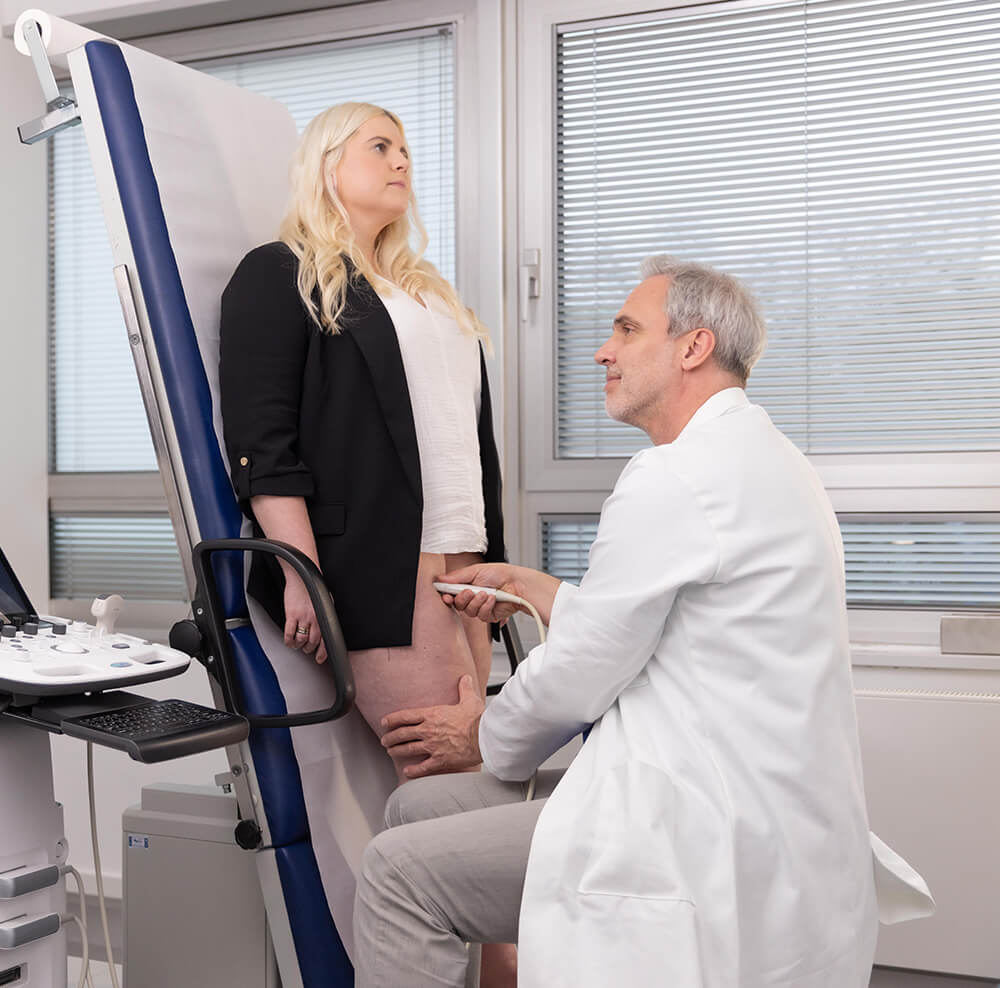
If you can answer yes to any of these points, I recommend that you consult your family doctor and/or a phlebologist (vein specialist).
A phlebologist deals with the diagnosis and treatment of lipoedema and can also rule out other causes of your symptoms (e.g. vascular diseases of the legs such as varicose veins) with an ultrasound examination.
Treatment options for lipoedema
There are both conservative and surgical treatment options for lipoedema.
Conservative therapy consists of consistently wearing compression garments during the day (if this helps to alleviate the symptoms) and manual lymph drainage, as this can also alleviate the symptoms.
Even if there is no increased water in the affected fatty tissue in pure lipoedema, which could be removed by manual stroking, lymphatic drainage has a pain-relieving effect for many sufferers.
It is also important to get enough physical exercise and optimise your eating habits - ideally under the professional guidance of a nutritional therapist.
The surgical treatment consists of suctioning out the increased subcutaneous fatty tissue in the affected areas (so-called liposuction). Liposuction is the most frequently performed aesthetic procedure in the world today and has a very low complication rate.
You can find more information on both forms of therapy on the corresponding subpage.
What are my next steps?
If you suspect that you have lipoedema, I recommend that you consult your family doctor or a vascular specialist (phlebologist, vascular surgeon, angiologist) or lymphologist.
The doctor will first conduct a detailed medical history interview with you and then perform a physical examination and, if necessary, an ultrasound of your leg vessels to rule out other diseases.
If you have lipoedema, further therapeutic steps can be planned in a joint consultation.
Background to lipoedema
In 1940, Dr E. Hines and Dr E. Allen, two doctors at the renowned Mayo Clinic in the USA, described for the first time a clinical picture that they could only observe in women. They noticed a symmetrical lateral increase in fatty tissue on both legs, which led to discomfort in the affected extremity. Obesity could also be present, but not necessarily.
For many decades, this condition was then forgotten and it was only at the beginning of the new millennium that it once again became the focus of public attention - also thanks to the ideal of beauty propagated on Facebook, Instagram and the like.
Today, more and more women are asking themselves whether they might be suffering from lipoedema, as they are unable to get to grips with the increased fatty tissue despite a conscious diet and sufficient physical exercise. In the worst case scenario, they feel hopelessly at the mercy of the potential disease and have lost a lot of their zest for life as a result.
On the other hand, there are women who have been on an odyssey from doctor to doctor for years and no one has been able to make the correct diagnosis, as the symptoms of lipoedema are often not well known, even among medical colleagues.
The aim of these lines should therefore be to clarify what lipoedema really is and, above all, what it is not. Research into lipoedema is still in its infancy and there are many myths surrounding this new disease, which has been heavily hyped in the social media.
Conclusion:
- Lipoedema is a disease that is currently very present in the media but is often associated with myths and misinformation.
- Lipoedema always involves symptoms - only increased fatty tissue without symptoms or an inharmonious body silhouette is not lipoedema.
- The diagnosis of lipoedema can sometimes be difficult to make because specific examination parameters (blood tests, imaging) are lacking.
- The pinch test on the legs and arms can make a useful contribution to the diagnosis.
- The causes of lipoedema are still unclear and the subject of current research. A hormonal change as a trigger and a familial predisposition are suspected.
- There are several successful treatment options for lipoedema, so there is no need to resign yourself as a sufferer.
- Lipoedema is not necessarily progressive, i.e. it does not necessarily worsen over the course of a person's life.
- If lipoedema is suspected, a vascular specialist or lymphologist should be consulted.
FAQ
A possible indication of the presence of lipoedema may be discomfort (especially pain) in increased fatty tissue on the legs or arms or localised pain on contact with e.g. partners, children or pets.
Differences in body proportions between the upper and lower body are possible but not conclusive and lipoedema also occurs with harmonious body proportions.
Both conservative and surgical treatment options are available.
The conservative approach emphasises wearing compression garments, manual lymphatic drainage, sufficient exercise and improving dietary habits.
The painful fatty tissue on the affected extremities is surgically removed by liposuction.
The first sign of the presence of lipoedema can be an always symmetrical increase in subcutaneous fatty tissue on the legs or arms, which is painful spontaneously or to the touch.
The first point of contact is usually your family doctor. Vascular specialists such as vascular surgeons, phlebologists or angiologists are the specialists for lipoedema alongside the lymphologist.
A vascular specialist can also rule out vascular disease as a differential diagnosis for pain in the extremities.
Lipoedema always involves pain in the laterally increased fatty tissue under the skin.
Although lymphoedema also leads to swelling of the extremities, it does not cause pain and often only occurs on one side, involving the feet or hands (which are never affected in lipoedema).
Lymphoedema can occur as a result of lipoedema if the lipoedema is associated with obesity, as obesity can lead to lymphoedema. Lipoedema in itself does not lead to lymphoedema.
Further information on lipoedema
What is lipoedema
Stadiums
Treatment
Impressions of the practice